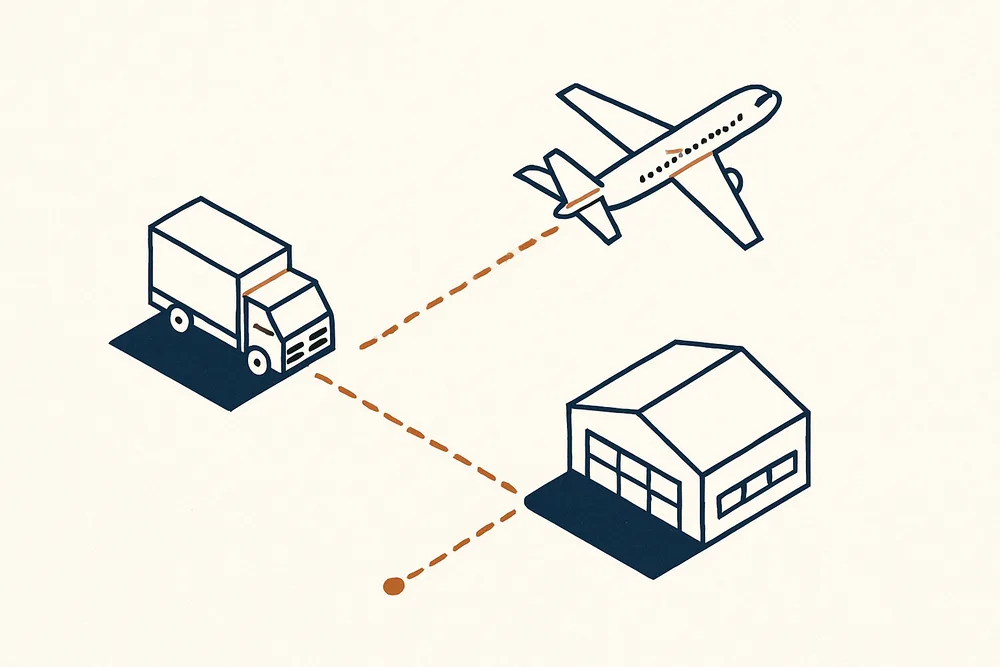
Why custom software for logistics and transportation?
Because every logistics operation is different — own fleet or couriers, single warehouse or multi-point, B2B or last mile — and enterprise suites force you to choose between overpaying or bending your operation to fit the software. The classic symptom in mid-sized companies: an ERP that knows about inventory but not routes, couriers managed inside their own platforms, and a team answering "where is my order?" by phone, checking three systems.
At Freshwork we build custom software that joins those pieces: information flows on its own between sales, warehouse, transport and customer, and the operation is managed from one place.
How does real-time tracking work?
Every delivery milestone — pickup, in transit, delivered, exception — is recorded once and propagated automatically to everyone who needs to see it: your control tower, the customer portal, and email or messaging notifications. The source can be a driver mobile app with GPS and proof of delivery, the courier's API, or both. The operational effect is direct: "where is my order?" tickets drop because the customer already knows, and your team stops working as a call center.
The control tower is built on the same data: on-time deliveries, pending orders by zone, exceptions requiring action — live indicators, not a spreadsheet someone assembles on Monday.
Lightweight WMS and TMS: custom, without the enterprise cost
A custom WMS or TMS makes sense when your operation is too specific for a spreadsheet but too small for an enterprise suite. We build the lightweight version: receiving, locations, picking and dispatch on the warehouse side; route planning, assignment and settlement on the transport side — only the modules your operation actually uses, integrated with your ERP and e-commerce. And if a mature SaaS covers your case well, we'll say so: part of our job is recommending you don't build when it doesn't make sense.
What track record does Freshwork have for demanding operations?
Over 10 years building platforms that hold up under real load, including the air transportation industry: for LAN Airlines we sustained a campaign with 191,219 registrations in 5 days and peaks of 2,580 concurrent users, with zero downtime. That same architectural discipline — queues for write peaks, failure-tolerant integrations, monitoring — is exactly what a logistics operation demands, where the software can't stop. If you want to evaluate where to start, write to us.